
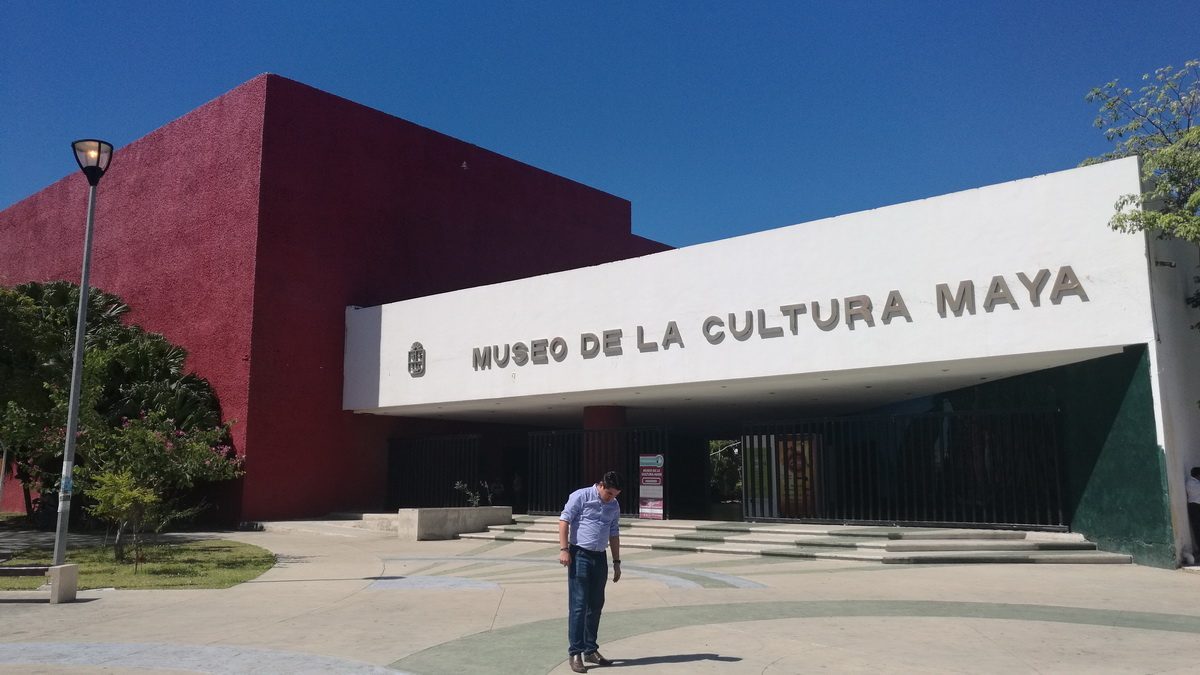
A museum devoted to the Maya world
In the centre of Chetumal, the capital of Quintana Roo, the Museum of Mayan Culture (Museo de la Cultura Maya) tells the story of one of the great civilisations of the Americas. Inaugurated in 1993, it is divided into eight sections that cover the expansion of the Maya people, their relationship with nature, their architecture, their economy and their worldview. At its heart stands the sacred ceiba tree, which the Maya used as a metaphor for the relationship between the three levels of the universe: the underworld, the terrestrial world and the heavens. Another of its most interesting areas is devoted to Maya science: the calendar, astronomy and the writing system.
This article follows the museum's own thread: from the first hunters to the arrival of the Spanish, and from temples and painted books to calendars, numbers and long-distance trade.
Origins: from nomadic hunters to the first Maya speakers
The human story of the region begins long before the first pyramids:
- 10,000 years ago, the first settlers were groups of nomadic hunters. An obsidian point from Los Tapiales is a reminder of that distant era.
- 7,000 years ago, agriculture began, as grinding tools found in the Santa Martha cave in Chiapas testify.
- 5,000 years ago, the first Maya-speaking groups occupied the area.
Three thousand years of history: the Maya timeline
A long folding timeline in the museum sets out the main periods of Maya history and, for each, the cities that flourished in the northern lowlands of the Yucatan Peninsula, in the central lowlands of the Petén and Belize, and in the highlands and Pacific coast of Guatemala and Chiapas.
Middle Preclassic (from c. 1000 B.C.)
Early communities appear at sites such as Becán and Dzibilchaltún in the north; Tikal, Uaxactún, Altar de Sacrificios, Ceibal and El Mirador in the central area; and Kaminaljuyú, Chiapa de Corzo and Izapa in the south. Common houses, like those of Dzibilchaltún, stood on simple platforms, and El Mirador was one of the earliest communities. Pottery styles such as Xe, Mamom and Charcas, and the carved stelae of Izapa, belong to this time.
Late Preclassic (from c. 300 B.C.)
This was an age of significant demographic growth and architectural development, visible at Cerros, Corozal, Tikal, El Mirador, Toniná and Chinkultic, as well as at Becán, Chicaná, Dzibilchaltún and Yaxuná in the north. In the south, the eruption of the Ilopango volcano caused an ecological imbalance that led to the abandonment of the Salvadoran highlands.
Protoclassic (from c. A.D. 50)
Populations declined in northern cities such as Acanceh and Becán, while in the central area sites like Cerros, Holmul, Barton Ramie, Tikal and Uaxactún continued to develop. Nohmul, near the Río Hondo, became a centre of trade and agricultural production. Along the Pacific coast, stelae in the Izapa style spread over a vast region, at sites such as Abaj Takalik, Chiapa de Corzo and El Baúl.
Early Classic (from c. A.D. 250)
In the north, Dzibilchaltún, Yaxuná, Oxkintok and, in southern Quintana Roo, Kohunlich, Dzibanché and Chacchobén were inhabited, while Becán lost population and was possibly abandoned. In the central lowlands—Tikal, Altun Ha, Palenque, Quiriguá—the influence of Teotihuacan was felt, and the use of the Long Count calendar was established. Stelae from Tikal portray rulers such as Lord Stormy Sky.
Late Classic (from c. A.D. 600)
This was the age of splendour. In the north the Puuc style developed at Uxmal, Sayil and Chichén Viejo and spread south to sites such as Edzná. In the central area, Palenque, Yaxchilán, Piedras Negras, Yaxhá, Copán, Quiriguá and Bonampak flourished, and Tikal was the largest and most important centre. Around A.D. 800, however, transformations began that culminated in the disintegration of the Classic Maya world. On the Pacific coast, Nahuatl-speaking groups established Santa Lucía Cotzumalhuapa.
Early Postclassic (from c. A.D. 900)
Around A.D. 950 Uxmal was abandoned, and years later Putun groups from the Gulf coast settled at Chichén Itzá. The reliefs of its great ball court show players moving towards a ball marked with a symbol of death.
Middle Postclassic (from c. A.D. 1200)
Mayapán was founded and Chichén Itzá abandoned. On the Caribbean coast, Tulum was decorated with murals inside its Structure 5. Groups of Mexicanised Chontal Maya from the Tabasco coast migrated to the heart of the Petén (Tayasal, Topoxté), and Quiché groups repopulated the highlands of Guatemala, with their capital at Utatlán.
Late Postclassic and the Spanish arrival (from c. A.D. 1450)
The fall of Mayapán led to the establishment of independent lordships along the northern coast of the peninsula, at sites such as Tancah. Xicalanco was an important trading enclave of the Mexica; Santa Rita and Tayasal also belong to this period. Then came the first contacts with the Spanish: Hernán Cortés saw Tayasal during his journey to the Hibueras, and in 1524 Pedro de Alvarado conquered Iximché and Utatlán in the Guatemalan highlands.
The Maya of southern Quintana Roo
The region around Chetumal was one of the most powerful in the Maya world. Its cities had large ceremonial centres, residential areas for the ruling families, extensive infrastructure and artificial water systems.
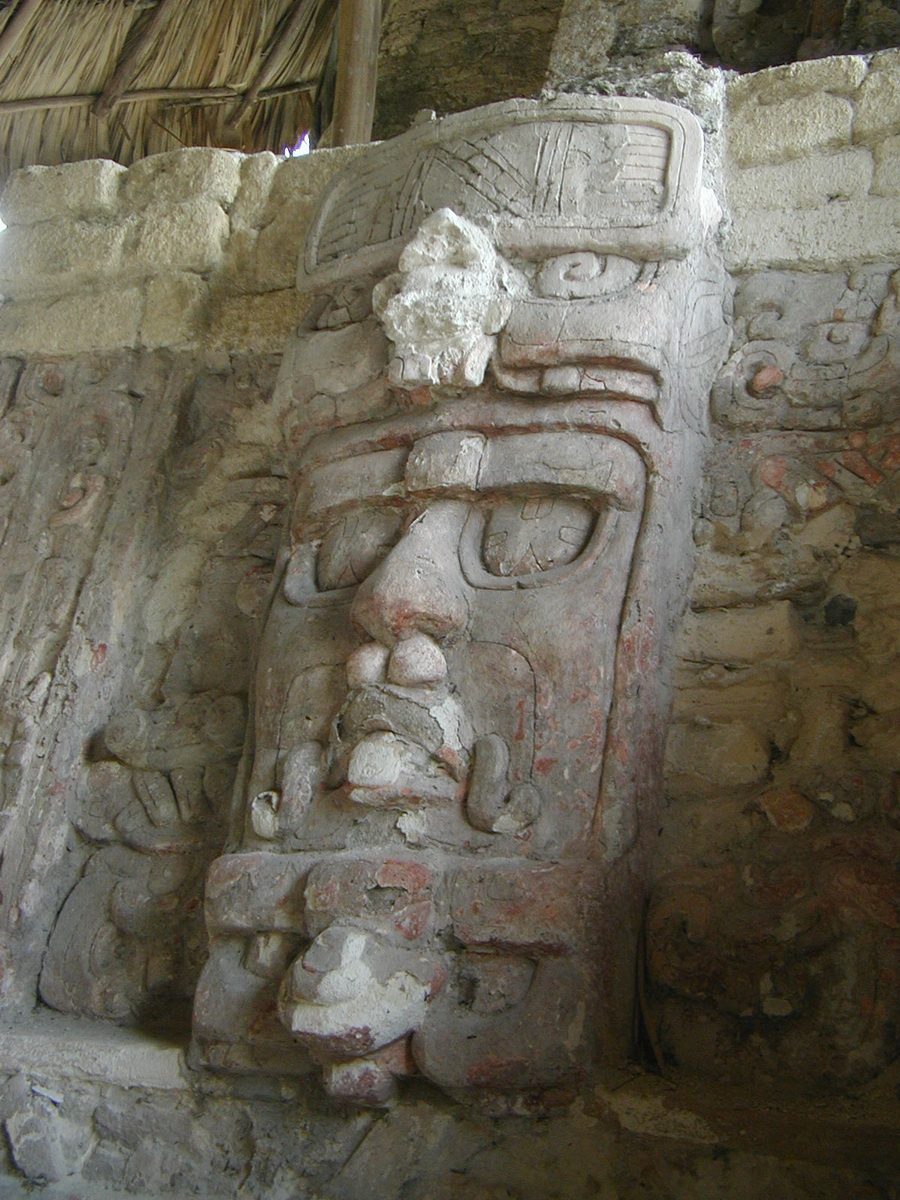
- Kohunlich: a city covering about 14 km². The city seen today was built in the early sixth century A.D. and abandoned in the twelfth or thirteenth, although its oldest platforms, in the Ya'axná sector, are attributed to around 200 B.C. Its original name is lost; "Kohunlich" comes from the English "Cohoon Ridge", after a tropical palm. Its architecture is related to the Río Bec style of southern Campeche and the Petén style of Guatemala and Belize. In its heyday all its buildings were covered in stucco and painted mainly red. A drainage system channelled rainwater into an artificial reservoir (aguada), and the residential, administrative and religious buildings were surrounded by the homes of farmers and craftsmen who produced food and worked shell and flint. Its famous Temple of the Masks was decorated with eight polychrome stucco faces in red and black, five of which survive.
- Dzibanché and Kinichná: a complex lying between the low forest of the northern peninsula and the rainforest of the Petén. Dzibanché, spread over some 40 km², was involved in the conquest of several towns carried out by rulers of the Kaan family over more than two centuries. Its occupation began in the Late Preclassic (around 300 B.C.), peaked in the Classic (400–700) and continued in some form until the Late Postclassic. Notable buildings include the Temple of the Cormorants, the Temple of the Captives and the Temple of the Lintels, in Teotihuacan style. Nearby Kinichná, the "House of the Sun", has a symmetrical three-level acropolis.
- Chacchobén: the "place of the red maize", one of the largest settlements of the Lakes Region, with its Great Platform (Gran Basamento) for ceremonies and residential compounds for the elite.
- Oxtankah: the largest and most important pre-Hispanic city discovered on Chetumal Bay, with its apogee in the Classic period. Legend says the first Mexican mestizaje took place here between the shipwrecked Spaniard Gonzalo Guerrero and the Maya noblewoman Zazil, but archaeology indicates that the city had been abandoned some 400 years before the Spanish arrived.
- Ichkabal: a monumental site near Bacalar, with structures up to 46 metres high and an extension of more than 30 km² according to the first surveys.
The sacred mountain: architecture and the Maya house
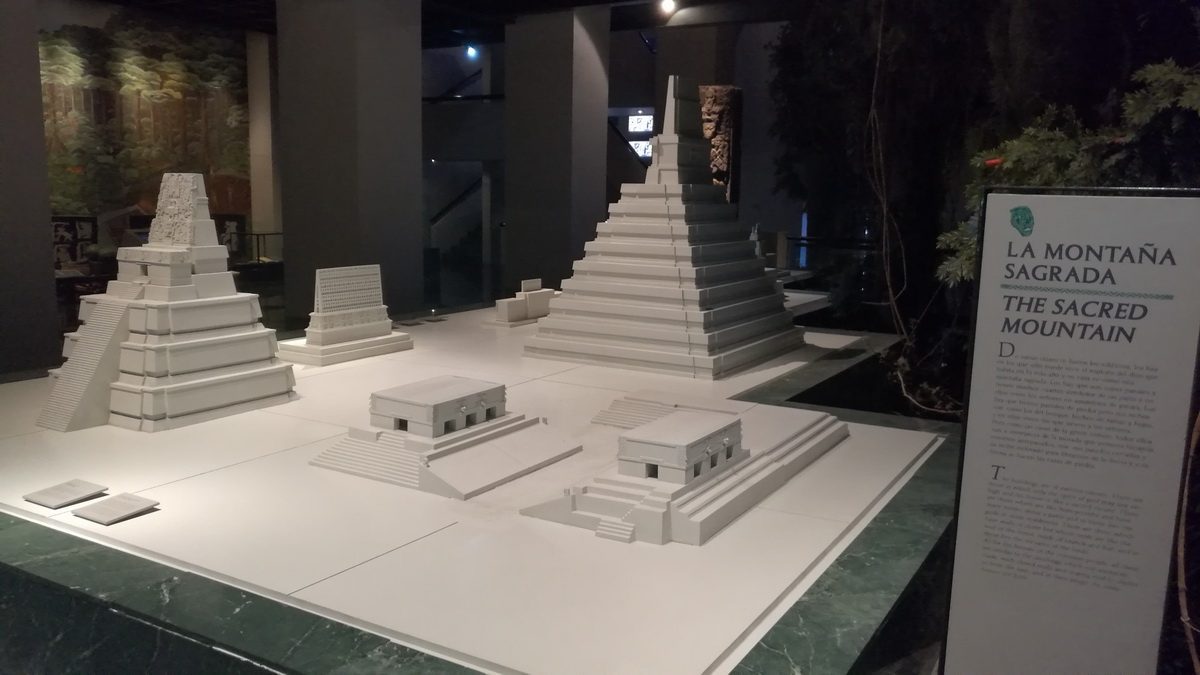
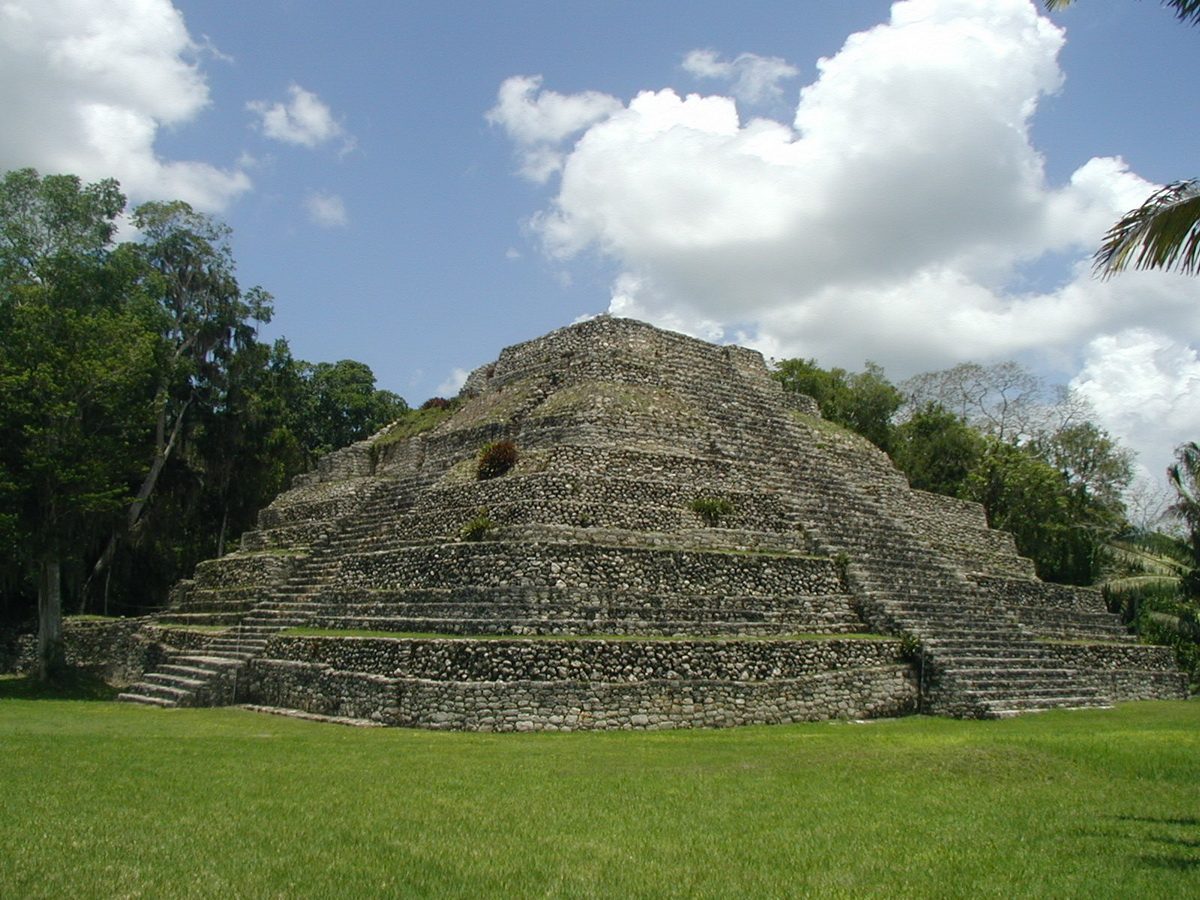
Scale models of temple-pyramids with tall roof combs and palaces on stepped platforms introduce Maya architecture. A museum text, written in the voice of the ancient Maya, explains the different kinds of buildings:
- Some are buildings in which only the spirit of the god who lives on high may dwell; his house is like a sacred mountain.
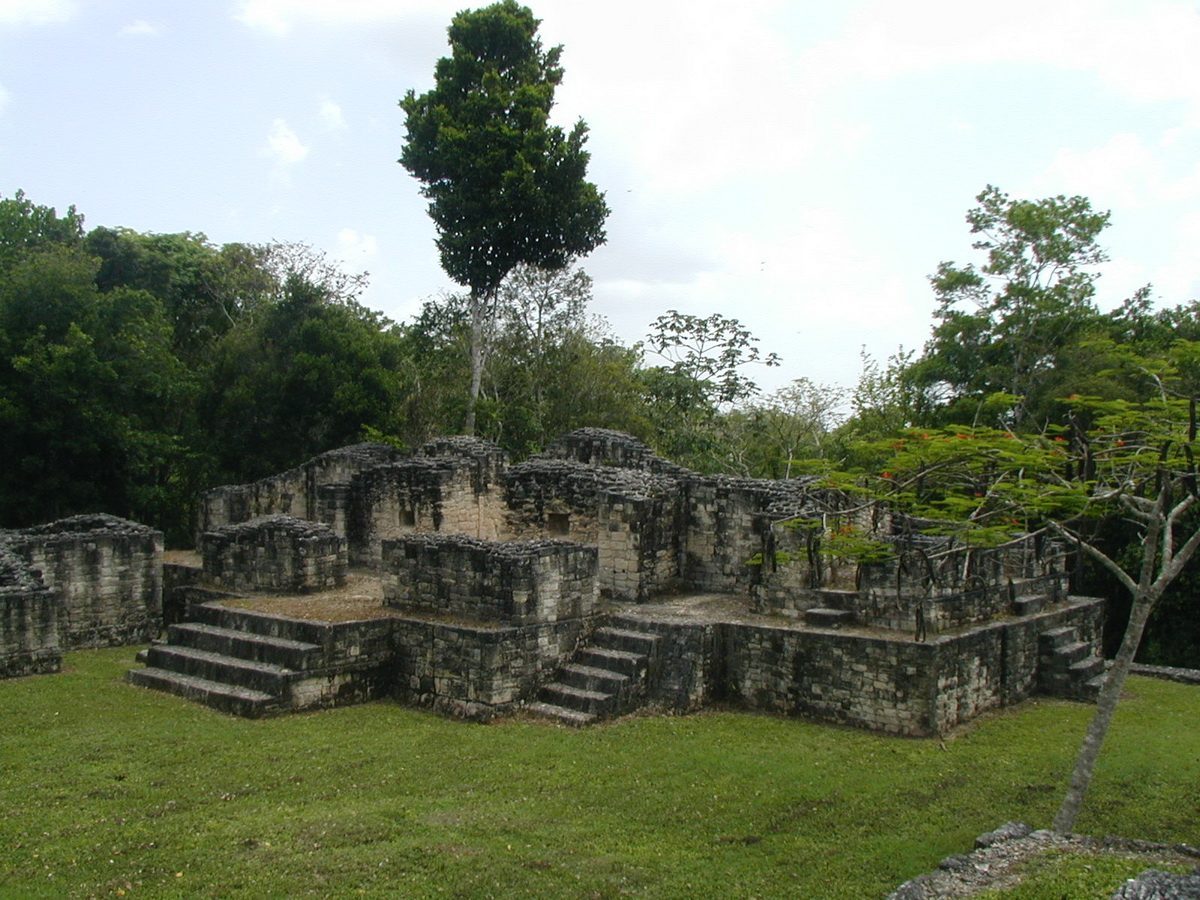
- Others are like honeycombs, with many rooms around a patio; there the lords live in stone chambers.
- Others have stone walls but roofs like those of the forest, made of branches and leaves, and there live those who serve the lords.
Yet all of them, like the houses of the common people, imitate the first dwelling built by the ancestors, with closed walls and a sloping roof to shelter from the rain. Stone temples and palaces were built in the image of that humble house.
Gods in the painted books
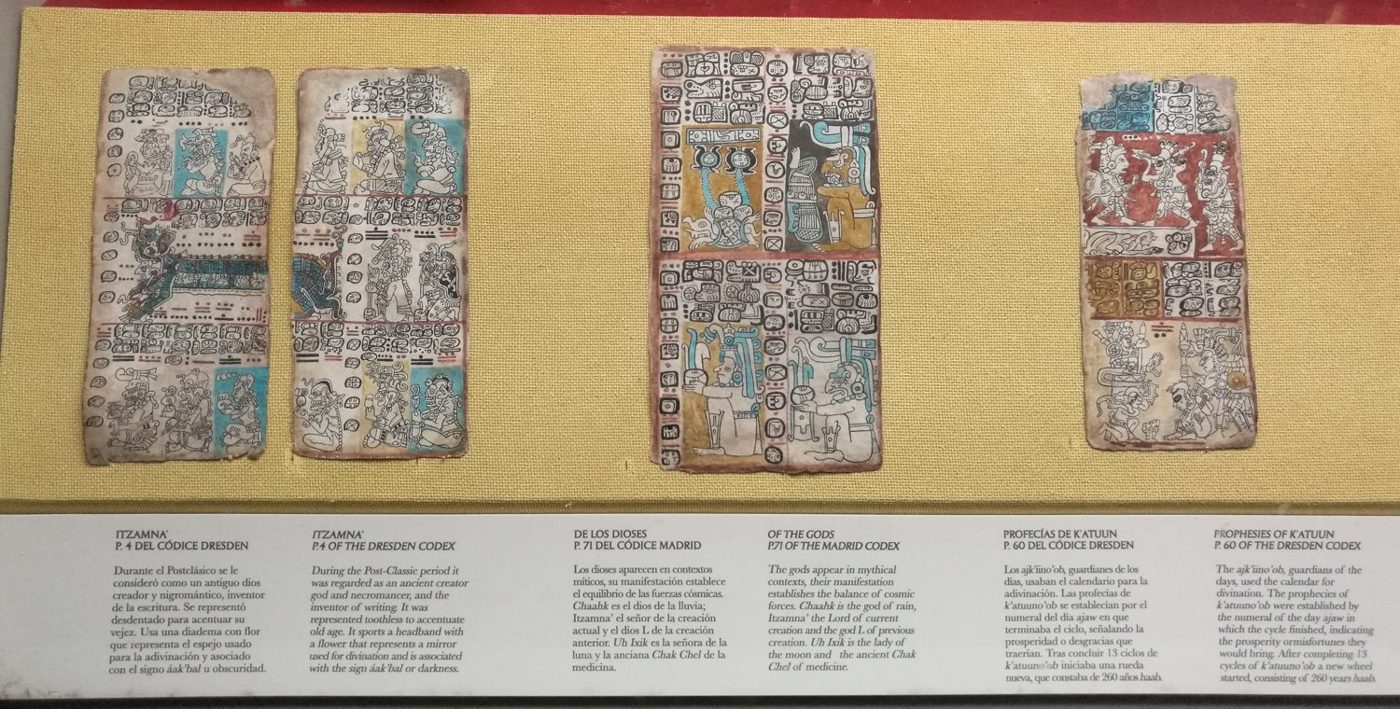
The Maya recorded their knowledge in folding books known as codices. Pages from the Dresden and Madrid codices introduce the main deities:
- Itzamna': in the Postclassic he was regarded as an ancient creator god, a necromancer and the inventor of writing. He is shown toothless to stress his old age, wearing a headband with a flower that represents the mirror used for divination, associated with the sign áak'bal, darkness.
- The gods appear in mythical contexts, and their presence keeps the cosmic forces in balance. Chaahk is the god of rain; Itzamna' is the lord of the present creation and God L of the previous one; Uh Ixik is the lady of the moon, and the old goddess Chak Chel rules medicine.
- Ix Chel, "Lady of the rainbow", was one of the most important goddesses of the Postclassic: deity of childbirth, pregnancy and fertility, and patron of spinning. Women made pilgrimages to her shrine on the island of Cozumel, known today as San Gervasio.
- A page of the Dresden Codex shows a torrential rain: Chak Chel pours water from a jar, above her the celestial crocodile spews torrents from its jaws, and below stands the black god, lord of the underworld. Both deities are linked to the last creation and the end of the world; among the waters appears the date 5 Éeb', marking the flood and the end of an era.
- The Maya also used psychotropic plants and stimulants. Tobacco was chewed or smoked to ease fatigue during vigils, and slightly more than 30 species were mixed with other plants to increase its effects.
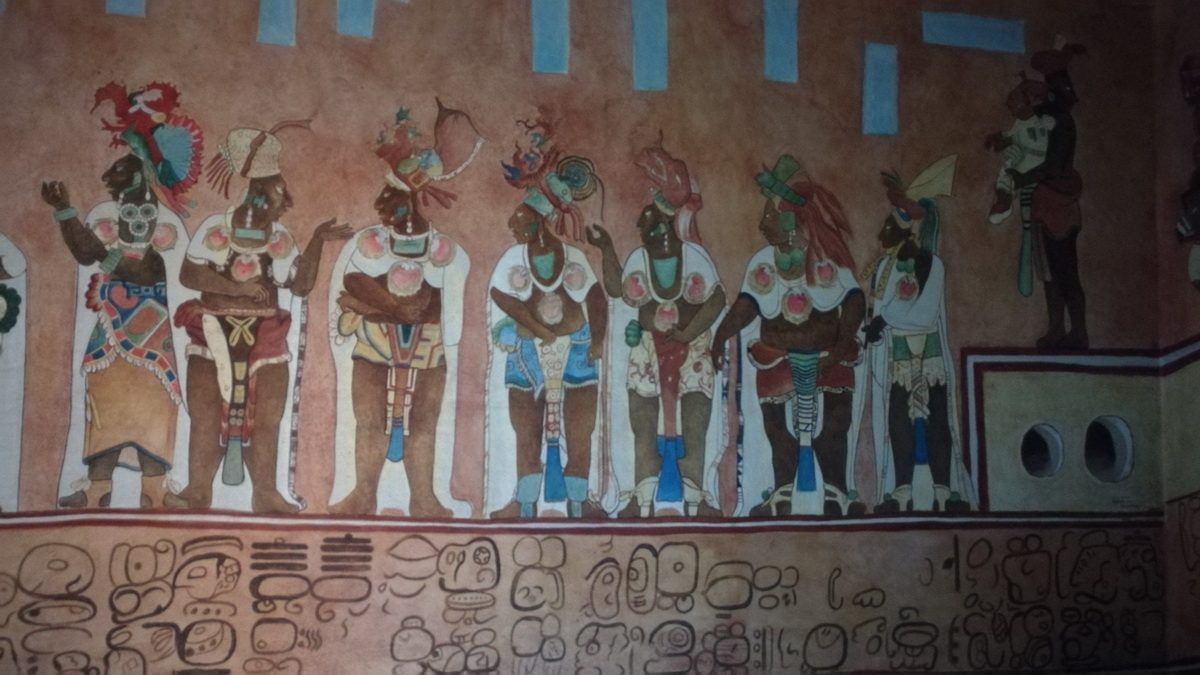
Next to these pages, full-size reproductions of painted murals show processions of lords in white mantles, jade ornaments and feathered headdresses above bands of hieroglyphic writing.
Time, calendars and prophecy
In their worldview, the ancient Maya perceived that their existence and everything created by their gods was in harmony with the cycles and regularities of nature. This cyclical conception of time encouraged the creation of a numbering system and of precise calendars. By recording the events that affected daily life—and that would inevitably return in the next cycle—they could soften their effects through rituals.
- The solar calendar or ha'ab' had 365 days: 18 months of 20 days plus five days considered unlucky, called wayeb'.
- The ritual almanac or tzolk'in had 260 days, combining 13 numbers with 20 day signs.
- There was also a lunar calendar.
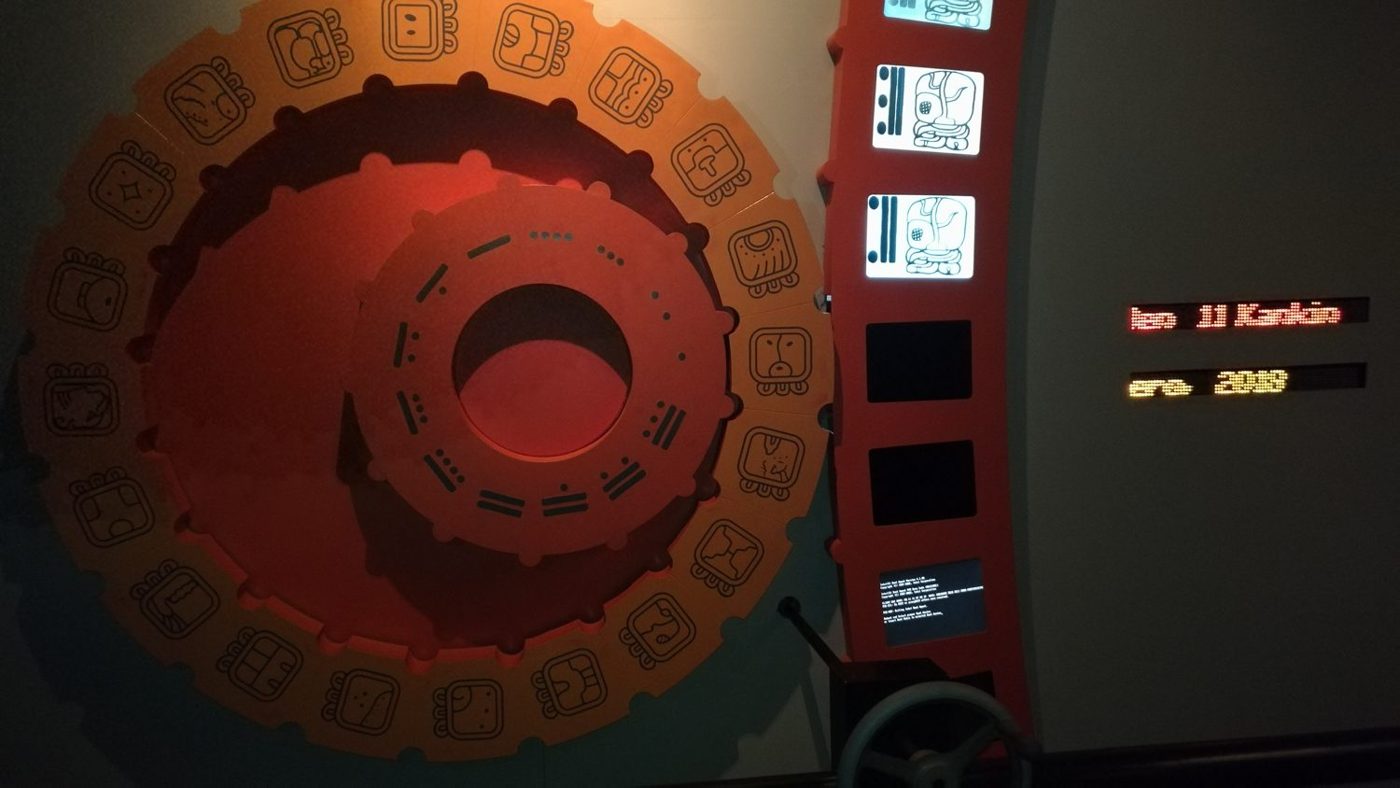
The ha'ab' and the tzolk'in turned like interlocking wheels and took 52 solar years (or 73 ritual cycles) to return to the same combination: the Calendar Round. This system was also used to open the narration of both historical and mythical events, whose starting point was the creation of the world on the date 4 Ajaw 8 Kumk'u. An interactive wheel in the museum lets visitors combine the day signs and numbers themselves.
"From the painted books we know that time sets the rhythm of the Universe and all creation," says another text in the voice of the Maya. The sacred calendar marked propitious and adverse times: with it the priest foretold the future of a newborn, predicted victory in war and anticipated the movements of the heavens. The gods ruled each period and its fortune, as well as a direction of the world with its own colour and bird. Divination was the task of the ajk'iin, "guardians of the days": the prophecy of each k'atuun was set by the number of the day Ajaw on which the cycle ended, and after 13 k'atuuns a new wheel of 260 years began.
The museum follows the spelling of Maya words recommended since the 1990s by the Academy of Mayan Languages of Guatemala—ajaw, kumk'u, tzolk'in—instead of older forms such as ahau, cumkú or tzolkín.
Numbers and the zero
The Maya wrote numbers with just three symbols: a dot (one), a bar (five) and a shell for zero. Values grew by position, from bottom to top: units (hu'n), twenties (winaak), then 400 (baak'), 8,000 (pik) and 160,000 (kalab) in a strictly base-20 count. Because the Maya used their numbers mainly to write dates, their system was not purely vigesimal: in the third position each dot was worth 360 rather than 400, to approximate the length of the year.
Every positional system needs a zero to show that a position has reached its limit and is empty again. According to the museum, the Maya did not invent the zero but adopted it from their neighbours of Olmec tradition on the Isthmus of Tehuantepec. The Maya word mih meant "zero" or "nothing".
Beyond the great rivers: trade and foreign influence
During the Classic period, Teotihuacan had a great influence on many regions of Mesoamerica. In the Petén its presence at Tikal is documented from the last third of the fourth century, as in the Petexbatún region and along the Pasión river, driven by commercial interest in jadeite. The fall of Teotihuacan around A.D. 650 created a new economic order that strengthened the Olmeca-Xicalancas or Maya-Putunes, merchants of the Gulf coast whose reach extended from the Maya area to the central highlands, as the murals of Cacaxtla confirm.
A map of trade routes links the Maya world to distant markets: from Xicalanco to the central highlands, and from the island of Cozumel to Oaxaca and to the central plateau.
A living culture
The Maya story did not end with the conquest. Around Felipe Carrillo Puerto, the heart of Quintana Roo's Maya zone, thousands of Maya people still live today, heirs of this millennia-old culture. From the first hunters to the builders of Kohunlich and Dzibanché, and from the priests who read the painted books to the families who still make tortillas over a wood fire, the Museum of Mayan Culture presents a civilisation that continues to astonish the world.